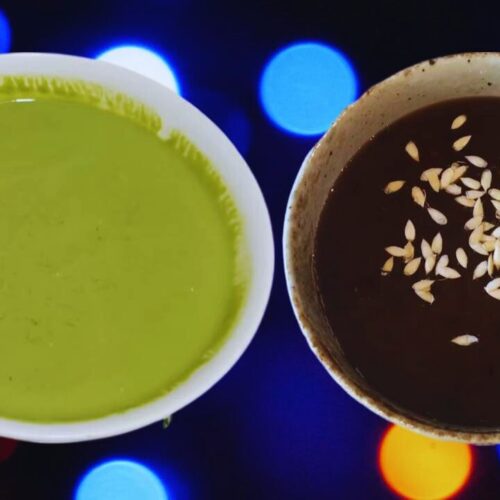
Dahi Vada Chutney
Dahi vada chutney can be of different types made from tamarind, jaggery, different seeds, and spices or a blend of coriander leaves, mint leaves, green chilies and other spice powders.
Ingredients
For Dahi Vada Tamarind Chutney:
- 200 grams Tamarind (ripe and with seed)
- 300 grams Jaggery (sliced into small pieces or powdered)
- 1 tsp Kashmiri red chili powder
- 3 tsp Cumin seeds
- 2 tsp Fennel seeds
- 1.5 tsp Black pepper
- ½ tsp Table salt
- 1 tsp Dry ginger powder
- 1 tsp Black salt
- ½ tsp Melon seeds
- 3 cups Warm water
For Dahi Vada Green Chutney:
- 80 grams Fresh coriander leaves (with the stalk)
- 20 grams Fresh mint leaves (pudina)
- 4 pieces Fresh green chilies medium
- 2 pieces Ice cubes
- 150 grams Curd (dahi)
- ¼ tsp Table salt
- ½ tsp Black salt
- ½ tsp Roasted cumin powder
- ½ tsp Chaat masala powder
- ½ tsp Lemon juice
Instructions
Dahi Vada Tamarind Chutney:
- Take 200 gms of ripe tamarind with seeds. Break it into small pieces if it comes in a chunk.
- Pour about 3 cups of warm water into the bowl, enough to soak all of the tamarind pieces completely. (Pro tip: You can add normal water but adding warm water will expedite things and make the tamarind softer, which is good for the texture of the tamarind chutney).
- Let it soak for about 10 minutes so that the tamarind melts nicely and the pulp separates.
- Mash the pulp with your hands.
- Take a strainer. Place it in a bowl.
- Pour the liquified tamarind onto the strainer to separate the pulp and seeds from it.
- Pour some more warm water and mash the pulp and seeds with your hand. Discard them and put the bowl with liquefied tamarind aside.
- Now, take a wok and heat it on a high flame on your gas stove.
- When the wok is hot enough, pour the liquified tamarind in it. (Pro tip: Do not pour it to the last drop. This will prevent the sand and other impurities from being added to the chutney).
- Now add 300 gms of jaggery, sliced into small pieces or powdered to the wok. (Pro tip: If you do not have jaggery at home, do not worry. You can regular sugar to the tamarind. However, adding jaggery will add to the taste and flavor of the tamarind chutney).
- Stir it nicely for a couple of minutes to mix the jaggery nicely and cook it on a high flame.
- Now add 1 tsp of Kashmiri red chili powder to the content in the wok. (Pro tip: Make sure that you keep stirring so that the jaggery does not stick to the wok).
- Bring it to a boil. When you see the chutney boiling, turn the flame to medium and let the chutney cook for another 15 to 20 minutes.
- While it cooks, in the meantime, take a frying pan and heat it on a low flame on your gas stove.
- When the pan is hot enough, add 3 tsp of cumin seeds, 2 tsp of fennel seeds, and 1.5 tsp of black pepper in it.
- Stir the spices continuously to dry roast them nicely.
- Turn the flame off when you notice the change in the color and you can smell the aroma of the roasted spices. Let it cool a bit and crush the roasted spices roughly, preferably in a mortar & pestle. Transfer it to a bowl and keep it aside. (Pro tip: Do not grind the roasted spices into a fine powder using a mixer-grinder. A coarse powder will give a fine texture and consistency to the tamarind chutney).
- By this time, the tamarind chutney should have lost enough water to become thick. Check it and boil it for some more time if needed.
- When you are satisfied with the thickness, add 1.5 tsp of the crushed roasted spices to the chutney.
- Then add ½ tsp of table salt to the chutney.
- Follow it with 1 tsp of dry ginger powder.
- Now add 1 tsp of black salt to the chutney and stir it to mix everything nicely. Cook for some more time so that the chutney becomes thick. (Pro tip: You can add a little bit of water if you do not want too thick a chutney).
- Check the consistency and then add ½ tsp of roasted melon seeds to the chutney. (Pro tip: You may also add cashew nuts to the chutney but make sure that you roast and crush them before adding).
- Mix it and let it cool. Pour it into a bowl and your tamarind chutney to have with dahi vada is ready.
Dahi Vada Green Chutney:
- Take a grinder.
- Put 80 gms of fresh coriander leaves with the stalk in it.
- Then add 20 gms of fresh mint (pudina) leaves to it.
- Now put 4 medium pieces of fresh green chilies into it.
- Follow it with 2 pieces of ice cubes. (Pro tip: You can crush the ice cubes into small pieces if you want. Adding ice cubes will enhance the green color of the coriander-pudina chutney and not make it excessively dark).
- Now, blend the contents nicely into a fine paste.
- Now, take another bowl with 150 gms of curd (dahi) in it.
- Whisk it nicely using a whisker. (Pro tip: Make sure you use thick curd. If you do not, you will not get the desired consistency in your green chutney).
- Then, add ¼ tsp of regular table salt to it.
- Follow it with ½ tsp of black salt.
- Also add ½ tsp of roasted cumin powder to the content in the bowl.
- Next add ½ tsp of chaat masala powder to it.
- Then add a little bit of the coriander-mint paste you made earlier to the content in the bowl.
- Finally, add ½ tsp of lemon juice to it.
- Whisk it nicely, add the remaining coriander-pudina paste, and your green coriander-pudina chutney is finally ready to be served with dahi vada.
Subscribe to My YouTube Channel Mitar Cooking!
Notes
While making the tamarind chutney, do not pour the entire mixture to the last drop to prevent adding the impurities in tamarind pulp to the chutney.
I prefer adding jaggery to my chutney. If you do not like jaggery or do not have it at home, consider using normal sugar as a replacement. However, adding jaggery enhances the taste of the chutney.
Roast the whole spices on a dry frying pan carefully so that you do not overcook or burn them in the process. This will render a bitter taste to the chutney. Roast them until they start changing color or you smell the natural aroma.
For the green chutney, I will suggest adding thick curd to it. This will render the desired consistency to the chutney. Remember, the ice cubes will liquify while grinding.
Always serve the chutneys chilled with dahi vadas. This will add to the freshness and render a cooling effect.
Nutrition Info (Estimation Only)
Nutrition Facts
Dahi Vada Chutney
Amount per Serving
Calories
115
Calories from Fat 9
% Daily Value*
Fat
1
g
2
%
Saturated Fat
0.3
g
2
%
Polyunsaturated Fat
0.1
g
Monounsaturated Fat
0.2
g
Cholesterol
1
mg
0
%
Sodium
480
mg
21
%
Potassium
152
mg
4
%
Carbohydrates
27
g
9
%
Fiber
1
g
4
%
Sugar
23
g
26
%
Protein
1
g
2
%
Vitamin A
476
IU
10
%
Vitamin C
3
mg
4
%
Calcium
43
mg
4
%
Iron
1
mg
6
%
* Percent Daily Values are based on a 2000 calorie diet.
Tried this recipe?Let me know how it was!
Follow Me @Mitar.Cooking or Tag #mitarcooking!
Like Page @MitarCooking or Tag #mitarcooking!
Follow Me @MitarCooking or Tag #mitarcooking!