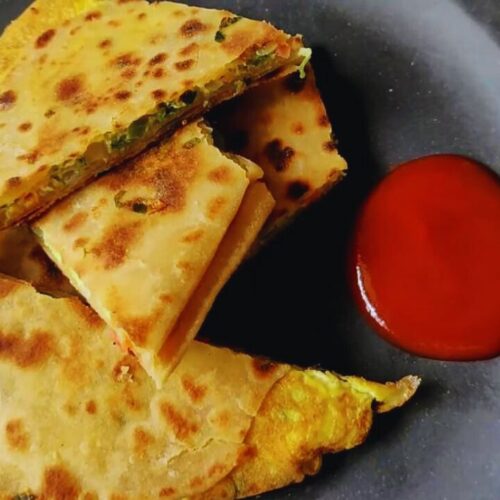
Egg Paratha
Egg paratha combines a wheat flour or refined wheat flour paratha which is stuffed with a spicy egg mixture inside. It is cooked to a crispy exterior in cooking oil.
Ingredients
For making the egg filling:
- 2 eggs
- 1 tbsp coriander leaves roughly chopped
- 1 tbsp tomato finely chopped
- 1 tsp green chilies finely chopped
- 2 tbsp onion finely chopped
- Salt as per taste
For making the dough:
- 1 cup wheat flour atta
- Salt to taste
- 1/3 cup water
- 1 tbsp vegetable oil cooking oil
While making the paratha:
- Wheat flour as required dry
- 1 tsp vegetable oil
While frying the paratha:
- 2 tsp of vegetable oil
Instructions
- Take a cup of wheat flour on a plate and add salt to taste. Mix it nicely. Then, gradually add 1/3 cup of water to make a soft dough. Now, add 1 tbsp of vegetable oil or cooking oil to it. Knead it again to make a softer and more elastic dough. Let it rest for about 15 minutes for the gluten to develop. (Pro tip: You can use refined wheat flour or maida and even leftover dough to make egg paratha instead of whole wheat flour. Do not add oil to the flour in the beginning. Always add it after making the dough. It will prevent rendering a short crust as you find in biscuits or cookies).
- While the dough rests, crack 2 eggs in a bowl and add 1 tbsp of coriander leaves (roughly chopped), 1 tbsp of tomato (finely chopped), 1 tsp of green chilies (finely chopped), 2 tbsp of onion (finely chopped) and salt as per taste. (Pro tip: You can personalize it by adding more spices like oregano, chili flakes, chili sauce, and other ingredients like spinach, cheese, mushrooms and more).
- Mix everything nicely and keep it aside.
- Now, take a portion of the dough.
- Flatten it in your hands to make like a small peda.
- Dab it in wheat flour nicely on both sides.
- Roll it to make a large roti of the size of the rolling surface.
- Sprinkle a bit of dry wheat flour on the roti and 1 tsp of vegetable oil. (Pro tip: This is a crucial step that you should not skip. This will help in opening the layers of the paratha easily to put in the egg stuffing).
- Rub it nicely up to the sides as shown in the image below.
- Fold it into half and press it. Then fold it into a quarter.
- Now, sprinkle a little bit of more atta on it and roll it into a shape of a triangle as shown in the image below.
- Now, heat a tawa on a high flame and transfer the paratha on it when hot. Let this side cook for about a minute or less on a low to medium flame.
- When you see small bubbles popping from below the paratha, flip it gently to cook the other side. Let it cook for about 10 to 15 seconds.
- By the time it cooks, put 1 tsp of vegetable oil on the paratha and spread it nicely on the surface. Flip it a couple of times to cook the paratha nicely. (Pro tip: Here, if you want you can also use ghee or butter on the surface of the paratha while frying it).
- Now, lift one of the layers with a spatula and put the egg mixture inside the pocket with a ladle. Push it inside to add more of the mixture. Let the egg mixture inside the paratha pocket cook on a low flame for about a minute.
- Now, if anything has flown outside the paratha pocket while cooking, lift it up, put it back to create like an envelope as shown in the image below. Let it cook for another minute or so. (Pro tip: Do not hasten the cooking process at this stage or else the egg mixture will not cook properly. Also, do not press the paratha pocket because the egg mixture may come out again. You may lift the broader side a bit instead so that the egg mixture moves up to the tip of the paratha).
- Now, when you see the color of the paratha changing slightly, put 1 tsp of vegetable oil on the surface and spread it with the spatula like before.
- Flip it to the other side. Your homemade delicious egg paratha is fully done when the surface turns nice golden-brown color.
- Repeat step 5 to 18 to make all the parathas. Transfer them to a plate. Serve them hot with tomato ketchup.
Subscribe to My YouTube Channel Mitar Cooking!
Notes
I have used a plain dough to make my egg paratha. You can flavor the dough as well, if you want, with carom seeds (ajwain), cumin seeds (jeera), coriander seeds (dhania), and more.
Do not add all of the water at once to make the dough. Adding gradually will not mess it up.
I have not covered the dough while resting. However, you may cover it with a cellophane paper or any lid and let it rest.
There is no need to grease both the sides of the paratha while frying, though there is no harm if you do so.
Press the sides of the paratha while frying. It will help the paratha to puff up nicely and the pocket to open up easily.
Nutrition Info (Estimation Only)
Nutrition Facts
Egg Paratha
Amount per Serving
Calories
377
Calories from Fat 126
% Daily Value*
Fat
14
g
22
%
Saturated Fat
3
g
19
%
Trans Fat
0.1
g
Polyunsaturated Fat
6
g
Monounsaturated Fat
4
g
Cholesterol
164
mg
55
%
Sodium
3571
mg
155
%
Potassium
161
mg
5
%
Carbohydrates
50
g
17
%
Fiber
2
g
8
%
Sugar
1
g
1
%
Protein
12
g
24
%
Vitamin A
313
IU
6
%
Vitamin C
2
mg
2
%
Calcium
41
mg
4
%
Iron
4
mg
22
%
* Percent Daily Values are based on a 2000 calorie diet.
Tried this recipe?Let me know how it was!
Follow Me @Mitar.Cooking or Tag #mitarcooking!
Like Page @MitarCooking or Tag #mitarcooking!
Follow Me @MitarCooking or Tag #mitarcooking!