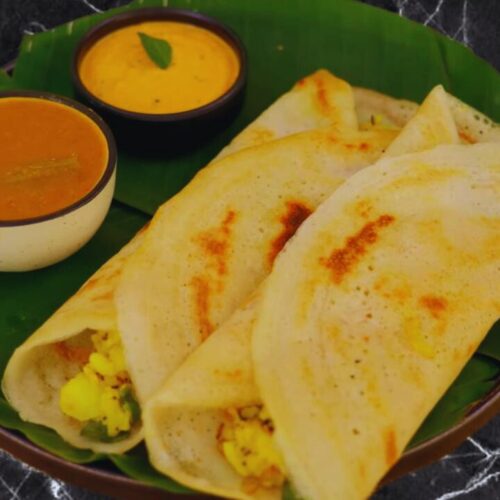
Masala Dosa
Masala dosa, first of all, is one of the dosa varieties, which is made of a thin, crunchy crepe that is made from a batter that has been naturally fermented and that consists of rice, urad dal, and methi seeds, and then it is filled with a mildly spicy potato-based masala. The batter is made by soaking, grinding, and fermenting to get the perfect flavor and lightness, and the filling is prepared by cooking the boiled potatoes by frying them with onions, spices, curry leaves, and green chilies.
Ingredients
For making the batter for dosa:
- 4 cups rice any variety
- 1 cup urad dal without skin
- 1 tbsp fenugreek seeds methi
- Water as required
- Salt to taste
For making the aloo masala:
- 4 pieces potatoes medium size, boiled, peeled, mashed roughly
- 2 tbsp cooking oil
- ¼ tsp asafetida hing
- 1 tsp mustard seeds
- ½ tsp cumin seeds
- 2 pieces green chilies finely chopped
- 12 pieces curry leaves
- ½ cup onion 1 large size, finely sliced
- ½ tsp turmeric powder
- Salt to taste
To fry the masala dosa:
- Cooking oil – as much as required
- Puri masala powder – as much as required
Instructions
- First, take 4 cups of rice (any variety) and 1 cup of urad dal (without skin), along with 1 tbsp of fenugreek seeds or methi in a bowl. Wash them very nicely and soak them in water. Cover and keep the bowl aside for at least 4 to 5 hours in water, if not overnight. (Pro tip: The best way is to soak rice and dal in the morning, grind them in the evening and keep them aside overnight so that they are well-fermented by the next morning).
- Wash the soaked rice and dal nicely, transfer them into a mixer and add a little bit of water to it. Grind them to make a smooth batter. Check the batter in between. If you feel that there are grains in it, grind a couple of more times accordingly. It should have a smooth and dropping consistency. (Pro tip: Do not add too much water while grinding the rice and dal. It will make the batter runny. The smoother the batter is with a dropping consistency, the easier it will be to spread it on the tawa).
- Now, transfer the batter to a deep-bottom container, cover it, and keep it aside for at least 12 hours more, if not overnight, to ferment properly. Check the batter in the morning. Mix it nicely once again. At this stage, the batter will be thick.
- Now, add water as required to make it slightly less thick. Then add salt to taste, and mix it nicely until the batter has a free-flowing consistency.
- Now, to make the aloo masala, heat 2 tbsp of cooking oil in a frying pan over a medium flame. When it is hot, put in ¼ tsp of asafetida (hing), 1 tsp of mustard seeds, and ½ tsp of cumin seeds, and sauté them for about 20 seconds or so. Then, add 2 pieces of finely chopped green chilies and about 12 pieces of curry leaves to it and fry them for another 20 seconds or so. (Pro tip: Do not add coriander leaves to the masala as it will overpower the traditional flavor of curry leaves in masala dosa).
- Follow it up with ½ cup or 1 large size of finely sliced onions and sauté them nicely until the onions turn soft and translucent. Then, add ½ tsp of turmeric powder to it and mix well. Cook for about 30 seconds until the raw smell of turmeric powder is gone.
- Now, add 4 pieces of medium-sized, boiled, peeled, and roughly mashed potatoes to it along with salt to taste. Mix well and cook for about a minute or so over a medium flame. Remove it from the gas stove when done. (Pro tip: Ensure that the potatoes are not finely mashed. Chunks of it add to the taste in every bite).
- Now, heat a non-stick tawa over a high flame. Put a little bit of cooking oil on it when hot and brush it over the surface with a tissue paper. (Pro tip: Dosa is usually made on cast-iron tawa for the right texture, crispiness, and color of the base. To make it non-stick, additionally, insert the tip of a fork on the outside of half of a peeled onion and rub it on the surface of the tawa. You may also do it with your hand instead of using a fork. This will also help the dosa come out perfectly).
- Now, sprinkle a bit of water on the tawa. Rub it with the tissue paper. Turn the flame of the gas stove to low. (Pro tip: This is a crucial step for making dosa. Water helps to determine the temperature and also reduces it if the tawa is too hot and prevents the dosa from burning at the bottom).
- Pour some batter in the middle of the tawa with a round ladle. Then, spread it by moving the bottom of the ladle in one direction, slowly and carefully.
- Now, turn the flame to high and put a bit of cooking oil or ghee (clarified butter) on the dosa surface and rub it with a spatula. Then, put a generous amount of the aloo masala on it along with a pinch of puri masala powder and let the base of the dosa cook nicely. Use a spatula to fold it carefully and remove when done.
- Your tasty and healthy homemade masala dosa is ready to enjoy. Serve it hot along with sambar and dosa chutney.
Subscribe to My YouTube Channel Mitar Cooking!
Notes
The proportion of rice and urad dal for the batter should be 1:4. Use the same cup or glass.
Though I have soaked rice and dal together, you can soak them separately if you want.
Methi promotes fermentation of the batter and also helps in enhancing crispiness and taste of the dosa as well as digestion.
Always grind rice and dal in batches. Grinding them all together at once may not result in a smooth texture of the batter. Grind intermittently.
I cover the vessel with cloth as it results in much better fermentation. Streaks and nets indicate proper fermentation of the dosa batter.
Nutrition Info (Estimation Only)
Nutrition Facts
Masala Dosa
Amount per Serving
Calories
366
Calories from Fat 36
% Daily Value*
Fat
4
g
6
%
Saturated Fat
0.4
g
3
%
Trans Fat
0.01
g
Polyunsaturated Fat
1
g
Monounsaturated Fat
2
g
Sodium
7
mg
0
%
Potassium
114
mg
3
%
Carbohydrates
71
g
24
%
Fiber
6
g
25
%
Sugar
0.5
g
1
%
Protein
11
g
22
%
Vitamin A
94
IU
2
%
Vitamin C
50
mg
61
%
Calcium
49
mg
5
%
Iron
3
mg
17
%
* Percent Daily Values are based on a 2000 calorie diet.
Tried this recipe?Let me know how it was!
Follow Me @Mitar.Cooking or Tag #mitarcooking!
Like Page @MitarCooking or Tag #mitarcooking!
Follow Me @MitarCooking or Tag #mitarcooking!