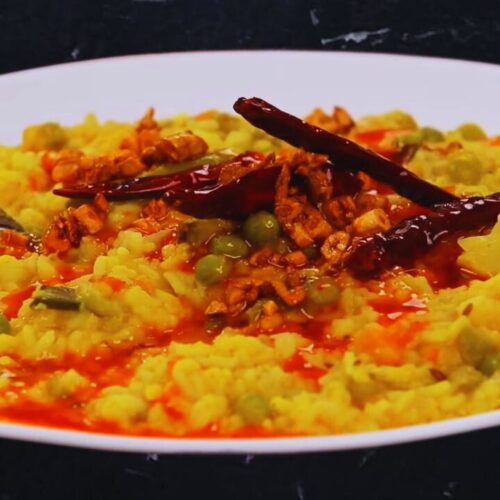
Vegetable Khichdi
Vegetable khichdi is made from a combination of rice and moong dal along with different vegetables like beans, carrots, green peas, cauliflower, and more, with or without an additional tadka to enhance its taste and flavor.
Ingredients
To make the khichdi:
- 1 cup rice
- 1 cup moong dal
- ½ cup onion finely chopped
- 1 tsp ginger garlic paste
- ¼ cup French beans finely chopped
- ¼ cup carrot finely chopped
- ½ cup green peas
- ½ cup cauliflower cut into small florets
- ½ cup tomato finely chopped
- 15 pieces curry leaves optional
- 2 pieces bay leaves
- 1 cinnamon stick 1 inch size
- 3/4 tbsp cumin seeds
- 2 pieces green chilies
- 2 tbsp ghee clarified butter
- 3 tbsp cooking oil
- 6 cups water
- 1 tsp salt
- 1 tsp turmeric powder
- 1 tsp garam masala powder
To make the tadka:
- 2 tbsp ghee
- 1 tbsp garlic finely chopped
- 4 pieces dry red chilies whole, without stalk
- ¼ tsp red chili powder optional
Instructions
- Take 1 cup of rice and 1 cup of moong dal in a bowl and mix them. Wash them nicely under running water, strain the water and keep the bowl aside. (Pro tip: Take small-grain rice to make the khichdi).
- Now, cut ½ cup of onion (finely chopped), ¼ cup French beans (finely chopped), ¼ cup carrot (finely chopped), ½ cup green peas, ½ cup cauliflower (cut into small florets), and ½ cup tomato (2 pieces, medium size, finely chopped) and keep them all on a plate aside.
- Heat a pressure on high flame and put 3 tbsp of cooking oil in it along with 1 tbsp of ghee (clarified butter). When the ghee melts, add 2 pieces of bay leaves, 1 cinnamon stick (1 inch size), 3/4 tbsp of cumin seeds, 2 pieces of green chilies (broken in smaller pieces), and 15 pieces of curry leaves (optional) to it. Sauté them on a medium flame for less than a minute. (Pro tip: Adding green chilies add to the taste and flavor of the khichdi. You may skip the curry leaves if you do not have them at home).
- When the cumin seeds are fried nicely and you can smell the aroma, add the chopped onions first and fry them for about two minutes on a medium flame.
- When the onions turn translucent, add 1 tsp ginger garlic paste. Fry them nicely for about 10 seconds on a medium flame.
- Once it is cooked, add all the other chopped vegetables to it, except the chopped tomatoes. Fry them for about 2 minutes on a medium flame. (Pro tip: Do not cook the vegetables for a long time as they are all in small pieces and will be pressure cooked).
- Now add the chopped tomatoes.
- Mix everything and cook them for another 30 seconds or so. Check the doneness and softness of the tomatoes and green peas.
- Now, add the washed rice and moong dal to the vegetable mixture. Turn the flame high and mix everything nicely. Stir it continuously to cook for another 30 seconds.
- Now, add 6 cups of water to the khichdi. Then add 1 tsp of salt, 1 tsp of turmeric powder, and 1 tsp of garam masala powder to it. Mix everything nicely. (Pro tip: You must add water 3 times of the quantity of rice and dal in the khichdi).
- Finally, add 1 tbsp of ghee to it and mix nicely.
- Close the lid of the pressure cooker and cook the khichdi on a medium flame up to 2 whistles. When it is done, turn off the flame of your gas stove and let the pressure cooker sit to cool down and lose pressure. (Pro tip: More than 2 whistles are not recommended; or else the khichdi will be overcooked or too soft and mushy).
- Open the lid when it has cooled down. Check the consistency of the vegetable khichdi. (Pro tip: If you feel the khichdi is too thick, dilute it by adding a cup of hot water).
- If it is perfect, transfer it to a serving plate. (Pro tip: The vegetable khichdi is just perfect to serve hot at this stage with papadum, Dahi, or achaar).
- For additional taste and flavor, make a tadka by heating 2 tbsp of ghee in a tadka pan on a high flame. When it melts and is hot, add 1 tbsp of finely chopped garlic. Sauté for about 5 seconds or so until they turn brown before adding 4 pieces of dry red chilies (whole, without stalk) to it and frying everything for another 5 seconds. Turn off the flame of the gas stove and let the ghee cool down just a little bit. (Pro tip: If you want add the tadka on the khichdi as it is now and skip the next step. If you don’t want it, go to the next step).
- Now, to make the tadka and the vegetable khichdi look more beautiful and taste spicier, add ¼ tsp of red chili powder (optional) to the tadka, mix it nicely and pour it on the khichdi. (Pro tip: You must add red chili powder when the ghee has cooled down a bit, or else it will burn and render a bitter taste to the khichdi).
- Your homemade tasty and spicy vegetable khichdi is now finally ready to enjoy.
Subscribe to My YouTube Channel Mitar Cooking!
Notes
I usually take equal amount of rice and moong dal to make this dish as it renders a balanced taste. You can alter the quantity according to your need and preference.
You need not soak the rice and dal to make khichdi. Soaking them will make the khichdi too mushy.
I have used both cooking oil and ghee to make the khichdi but you can use only cooking oil or only ghee if you want.
You can add more vegetables, both in quantity and type, to the khichdi according to your preference.
Rice, dal, water, and other ingredients should be measured with the same cup.
Nutrition Info (Estimation Only)
Nutrition Facts
Vegetable Khichdi
Amount per Serving
Calories
352
Calories from Fat 126
% Daily Value*
Fat
14
g
22
%
Saturated Fat
5
g
31
%
Trans Fat
0.02
g
Polyunsaturated Fat
2
g
Monounsaturated Fat
6
g
Cholesterol
20
mg
7
%
Sodium
73
mg
3
%
Potassium
266
mg
8
%
Carbohydrates
46
g
15
%
Fiber
7
g
29
%
Sugar
3
g
3
%
Protein
12
g
24
%
Vitamin A
1156
IU
23
%
Vitamin C
82
mg
99
%
Calcium
67
mg
7
%
Iron
2
mg
11
%
* Percent Daily Values are based on a 2000 calorie diet.
Tried this recipe?Let me know how it was!
Follow Me @Mitar.Cooking or Tag #mitarcooking!
Like Page @MitarCooking or Tag #mitarcooking!
Follow Me @MitarCooking or Tag #mitarcooking!