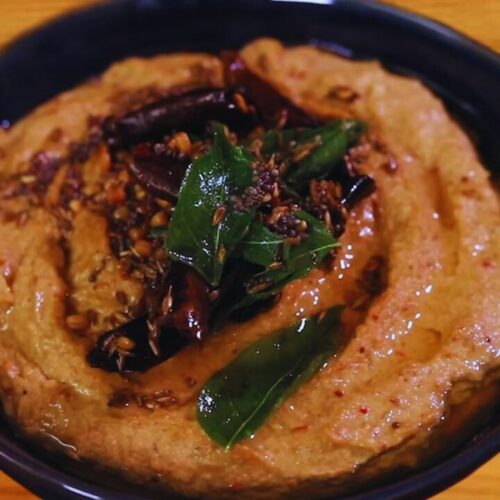
Peanut Chutney
Peanut chutney comprises roasted peanuts, onion, and other ingredients. It is tempered with cumin and mustard seeds, urad dal, and curry leaves for boosted flavor.
Ingredients
To make the peanut paste:
- 1 cup peanut
- 3 tsp white oil
- 1 piece onion large, finely chopped
- 8 cloves garlic deskinned
- 8 pieces dry red chilies
- 1 piece tamarind of the size of a gooseberry, broken into small pieces
- 1 tsp rock salt
- Water As needed
For tempering the peanut paste:
- 2 tsp white oil
- 1 tsp split black gram lentils urad dal
- 1 tsp mustard seeds
- 1 tsp cumin seeds
- 3 pieces dry red chilies broken in half
- 1 tsp asafetida
- 10 pieces curry leaves
Instructions
- Take a wok or a frying pan and heat it on a medium flame on your gas stove. When it is hot, put 1 cup of peanuts in it. Stir continuously for about 5 to 6 minutes to dry roast the peanuts on a medium-low flame until they are fully brown in color. (Pro tip: If you do not want or have the time to roast the peanuts, you can skip this step and use store-bought, pre-roasted peanuts in its place).
- When you see that the peanuts have turned to a lovely dark-brown color, that is what you need. Turn the flame of your gas stove off. Transfer them from the wok to a wide tray and set it aside to cool them down completely.
- While the peanuts are cooling down, add about 3 tsp of white oil in the pan to sauté a few other ingredients for the chutney. When the oil is hot enough, put 1 large piece of onion, finely chopped, in it. Follow it with 8 pieces of fresh and deskinned garlic cloves. Then, add 8 pieces of dry red chilies in it. (Pro tip: If you want your peanut chutney to be spicier, add more red chilies to it. If you want less, reduce the number of red chilies).
- Sauté the ingredients for a few minutes until the onions turn translucent and the other ingredients are not raw anymore.
- At this point, add 1 piece of tamarind the size of a gooseberry. Make sure to break the tamarind into small pieces. Sauté all the ingredients again for a couple of minutes more until everything is cooked nicely and the onions look nice and juicy.
- Once the cooking process is done, turn off your gas stove, transfer the ingredients from the frying pan to a bowl, and set it aside to cool down completely.
- Now, while these ingredients are cooling down, you will have to remove the skin from the roasted peanuts. Use your hand first to crush them gently. Then rub them in your hand. The loose skin will come off easily.
- Hold the tray forward, blow from your mouth and the skin will be separated easily. (Pro tip: You may perform this step near the window or outside your kitchen so that your kitchen does not become dirty with peanut skins scattered all over. However, I didn’t).
- While removing the skin, if you feel that the peanuts are still hot, transfer them from the tray to a bowl and keep them aside for some more time so that they cool down even further at room temperature.
- When all the ingredients have cooled down completely, take a clean grinder and transfer the roasted peanuts to it first.
- Then, transfer the fried ingredients to the grinder. (Pro tip: Do not rush things and transfer them to the grinder if the ingredients are even slightly warm. The heat will eventually affect the taste and flavor of the chutney).
- Now, to the ingredients in the grinder, add 1 tsp of rock salt.
- Grind the ingredients, first without adding any water in the grinder, into a somewhat coarse powder. Add a little bit of water to it and grind it again. (Pro tip: The grinder may find it difficult to rotate freely at this point. Do not worry).
- Now, add some more water and grind it all over again to make a paste, now with much ease and a relatively smoother texture. (Pro tip: Make sure that you do not grind the ingredients too smooth. It should be a bit coarse because you will have to grind it a couple of times more. It is only in this way you will get to enjoy the desired texture of your peanut chutney).
- Check the texture. It should be done by now. If not, add some more water if needed and grind it again to get a nice and smooth paste. (Pro tip: Always add water in a small amount and grind every time after it. This will help you achieve the desired consistency. Remember, if it is too thick, you can add more water. But if it is runny, you cannot take it back).
- Mix the paste nicely. Check that the consistency is perfect.
- When you are satisfied with the texture, transfer the peanut paste from the grinder to a bowl and keep it aside.
- Now, to complete making the peanut chutney, you will need to prepare the tempering ingredients. Take a tadka pan, heat it, and put about 2 tsp of white oil in it.
- When the oil is heated up, add 1 tsp of split black gram lentils (urad dal) in it.
- Then add 1 tsp of mustard seeds to it.
- Also add 1 tsp of cumin seeds to the hot oil. (Pro tip: At this point, you should be careful because the mustard seeds and cumin seeds will start crackling, and sprinkle hot oil around).
- Now, once these seeds stop splattering, indicating that they are quite cooked, add 3 pieces of dry red chilies to the pan. You may break them in half.
- Follow it with 1 tsp of asafetida.
- Finally, add 8 to 10 pieces of fresh curry leaves to the tempering ingredients in the tadka pan.
- Sauté everything for a few seconds until the curry leaves are cooked nicely and are raw no more.
- Transfer a portion of the prepared tempering to the bowl containing the peanut paste immediately.
- Mix the tempering with the chutney nicely.
- Finally, put the remaining tempering ingredients to the bowl and your tasty, irresistible, homemade peanut chutney is ready to be served with some hot idlis, dosas, and a variety of other dishes and snacks.
Subscribe to My YouTube Channel Mitar Cooking!
Notes
Roast the peanuts perfectly and evenly for a rich flavor and taste.
You can use pre-roasted peanuts from the stores to make this chutney. However, I prefer roasting them at home.
I like my chutney spicy. You can modify the heat according to your taste preference.
Do not use too much tamarind to the chutney. It will suppress the flavor and taste of peanuts.
The peanut paste should not be too thick or too watery
Nutrition Info (Estimation Only)
Nutrition Facts
Peanut Chutney
Amount per Serving
Calories
129
Calories from Fat 63
% Daily Value*
Fat
7
g
11
%
Saturated Fat
3
g
19
%
Trans Fat
0.01
g
Polyunsaturated Fat
1
g
Monounsaturated Fat
2
g
Sodium
271
mg
12
%
Potassium
122
mg
3
%
Carbohydrates
15
g
5
%
Fiber
1
g
4
%
Sugar
11
g
12
%
Protein
3
g
6
%
Vitamin A
371
IU
7
%
Vitamin C
42
mg
51
%
Calcium
33
mg
3
%
Iron
0.5
mg
3
%
* Percent Daily Values are based on a 2000 calorie diet.
Tried this recipe?Let me know how it was!
Follow Me @Mitar.Cooking or Tag #mitarcooking!
Like Page @MitarCooking or Tag #mitarcooking!
Follow Me @MitarCooking or Tag #mitarcooking!