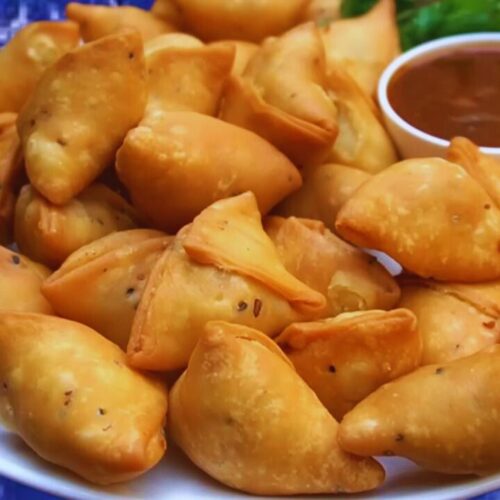
Vegetable Samosa
Vegetable samosas are made with a potato and peas filling complemented by aromatic spices, raisins, and more. It is stuffed inside a cover made of flour and then fried in cooking oil.
Ingredients
To make the dough:
- 2 cups refined wheat flour maida
- ½ tsp salt
- 1 tsp sugar
- ½ tsp carom seeds ajwain
- 2 tbsp refined oil
- Water As required
- Oil For brushing
To make the filling:
- 6 pieces potatoes small to medium pieces
- ¼ cup green peas
- Water As required
- 1 tbsp refined oil
- ½ tsp cumin seeds
- 1 tbsp cashew nuts broken pieces
- ½ tbsp raisins
- 1 piece onion medium, finely chopped
- 3 pieces green chilies finely chopped
- 1 tsp ginger deskinned and finely chopped
- 1 tsp garam masala powder
- 1 tsp chaat masala powder
- ½ tsp salt
- ¼ cup coriander leaves
For deep frying:
- Refined oil As required
Instructions
- First, to make the dough, take a bowl, put 2 cups of refined wheat flour (maida), ½ tsp of regular table salt, 1 tsp of sugar, ½ tsp of carom seeds (ajwain), and 2 tbsp of refined oil in it. Mix everything nicely to make the dough for the samosas. (Pro tip: Do not add too much water at once. Add water gradually as required because you will need stiff dough for making the samosas. Also, do not over-knead the dough).
- Now, brush the dough with a little bit of oil. This will prevent it from drying and keep it soft. Let it rest for about 1 hour or so. You may cover the dough with a piece of moist cloth.
- In the meantime, wash and clean 6 small to medium pieces of potatoes. Put them in a pressure cooker along with ¼ cup of fresh green peas, add an adequate amount of water and pressure cook them for about 4 to 5 whistles on a medium flame. When done, cool the potatoes, peel the skin, and cut them into small pieces.
- Now, take a kadai or a frying pan, heat it, and put 1 tbsp of refined oil in it. When the oil is hot, add ½ tsp of cumin seeds in it and let it crackle. Now, put 1 tbsp of broken cashew nuts and ½ tbsp of raisins in it and stir them for about a minute or two to roast them nicely.
- When the raisins have swollen up and the cashew nuts start to change their color, add 1 medium-sized onion (finely chopped), 3 pieces of green chilies (finely chopped), and sauté them for a minute or two until the onions turn translucent.
- Now, add 1 tsp of deskinned and finely chopped ginger and sauté along.
- Now, when the onions turn to a nice golden brown color, add the pieces of boiled potatoes and green peas to them. Mix them nicely.
- Next, add 1 tsp of garam masala powder, 1 tsp of chaat masala powder, and ½ tsp of salt to it. Stir well for about a minute and also mash a few pieces of potatoes.
- Finally, add ¼ cup of fresh coriander leaves, mix them well, turn off the gas stove, and let it sit for a while so that the ingredients cool off completely.
- Now, take a small portion of the dough and make fairly large dough balls. Take one of these balls at a time, roll it out in an oval shape, and then cut it into half. (Pro tip: If you want to make mini samosas, do not roll the dough too long).
- Take one of the two pieces, rub a little bit of water on the wider part, and fold it into a cone shape.
- Place a little bit of the filling into the cone. (Pro tip: Make sure that you do not overfill the cone with the filling, or else it will be hard to seal it).
- Rub a little bit of water on the ends of the dough this time and seal the edges to complete the cone. The cones should be made carefully so that it the samosa sits on its base. Now, one piece of samosa is ready for frying. Repeat steps 10, 11, 12, and 13 to make all the samosa cones.
- Now, to deep fry the samosas, take a heavy-bottom kadai, pour an adequate amount of oil into it, and heat it on a low flame. When it is warm enough, put the samosas carefully into the oil so that you do not splash hot oil. (Pro tip: Note that the oil should not be too hot. Otherwise, it will fry the coating quickly and burn it while the stuffing inside will not be cooked properly. Low and slow cooking is the best way to deep fry samosas).
- Let them cook for about 10 minutes. Stir them occasionally to fry them evenly on both sides. Remove them when they turn to a nice golden brown in color. (Pro tip: Do not put too many samosas at a time. Fry them in intervals. This ensures proper cooking and frying of every piece).
- Your homemade samosas are ready. Lay them on a plate and serve them hot along with tamarind, mint, or coriander chutney.
Subscribe to My YouTube Channel Mitar Cooking!
Notes
Make the dough for the vegetable samosas very carefully. I usually add water gradually to achieve a stiff consistency. Do not over-knead it as it can affect the eventual texture of the samosas.
Rest the dough for some time for best results. I typically brush a little bit of oil on it to prevent it from drying and breaking.
Boil the potatoes and peas nicely. This will help in easy mashing and proper cooking, thereby rendering the right texture to the samosas.
While roasting the nuts and raisins, make sure you do not burn them. This will make the samosas taste bitter.
Ensure that the green chilies and onion pieces are just translucent. Do not overcook as it will affect the aroma and sweet taste of the stuffing.
Nutrition Info (Estimation Only)
Nutrition Facts
Vegetable Samosa
Amount per Serving
Calories
273
Calories from Fat 81
% Daily Value*
Fat
9
g
14
%
Saturated Fat
1
g
6
%
Trans Fat
0.03
g
Polyunsaturated Fat
2
g
Monounsaturated Fat
5
g
Cholesterol
1
mg
0
%
Sodium
64
mg
3
%
Potassium
197
mg
6
%
Carbohydrates
41
g
14
%
Fiber
4
g
17
%
Sugar
2
g
2
%
Protein
8
g
16
%
Vitamin A
61
IU
1
%
Vitamin C
2
mg
2
%
Calcium
19
mg
2
%
Iron
3
mg
17
%
* Percent Daily Values are based on a 2000 calorie diet.
Tried this recipe?Let me know how it was!
Follow Me @Mitar.Cooking or Tag #mitarcooking!
Like Page @MitarCooking or Tag #mitarcooking!
Follow Me @MitarCooking or Tag #mitarcooking!